
Transportation projects
The DNR's transportation liaison staff appreciates the importance of working with WisDOT and municipalities to utilize cost-effective, practical measures to advance transportation projects while protecting the environment.
The DNR's Environmental Analysis and Sustainability program (EAS) works cooperatively with the Wisconsin Department of Transportation (WisDOT) and with local highway transportation departments to avoid and minimize impacts on natural resources with the construction and maintenance of highways, roads, bridges, culverts, airports, railways and harbors. Each county has an EAS regional staff person who serves as the transportation liaison contact.
Building and maintaining transportation infrastructure can result in environmental impacts on waterways, wetlands, fisheries, endangered species and other resources. Crossing waterways and wetlands with roads, bridges, culverts and runways can result in water flow changes and habitat impacts. Aquatic habitats can be lost due to shoreline armoring and dredging activities. Siltation of waterways and wetlands can result from inadequate erosion control measures on construction projects. Fish and other aquatic animals can be blocked from passing through an improperly designed bridge or culvert.
DNR Transportation Liaisons have a long history of working with transportation designers and builders at the state and municipal levels. Working cooperatively has resulted in saving many acres of wetlands, creating safe passage under roads for numerous herptiles and small mammals, and many miles of streams flowing freely for navigation and fish passage while creating safer roads in Wisconsin.
If you are a municipal road manager or representative, please contact the DNR transportation liaison assigned to your county to coordinate the environmental aspects of road and road-stream crossing repairs due to flooding. All road and/or road-stream crossing repairs due to flood damage, conducted within waterways and/or wetlands, will require appropriate DNR authorization.
DNR recognizes that road and road-stream crossing damages during an active flood emergency may present imminent danger; in these cases, DNR understands that some temporary and immediate repairs are needed to re-open roadways. In these situations, DNR will coordinate permitting with the Municipality when flood response subsides. Additionally, some activities can be discussed and reviewed over the phone with the DNR Transportation Liaison, and work can begin as agreed upon.
During flood response and recovery, there is a lot of information and communication going on simultaneously that can be confusing and leave a road manager perplexed. Please do not hesitate to reach out again to your DNR Transportation Liaison, Department of Transportation (DOT), Wisconsin Emergency Management (WEM), County Highways Department, and your County Emergency Management Department. To help Municipalities with road and road-stream crossing flood recovery get work funded, DNR has assembled some common flood damage funding sources.
Please contact the DNR transportation liaison prior to beginning work. The Transportation Liaison will go over your proposal and help you identify DNR permits and/or contacts that may be necessary from other Department programs.
Municipal Transportation projects include construction, reconstruction or maintenance of a roadway, bridge, arch or culvert that is being carried out under the direction and supervision of a city, village, town or county and may impact waterways and/or wetlands. Please check out Overview of The Transportation Program for more information.
Best management practices (BMPs)
Best management practices (BMPs) are vital to successful municipal transportation projects. Please view our presentation titled BMPs for Design Considerations before designing the project and BMPs for Construction to plan for the next project phase.
Are you working in a roadside ditch? Check out BMPs for Ditches.
Also available – Road Right of Way Mowing BMPs.
Permits
Local units of government may need to obtain waterway, wetland and storm water permits for a proposed transportation project. Local transportation officials and their consultants can find permit information and forms below.
Please contact the transportation liaison for your county to determine if your project needs a permit. Please review our presentation, Permits for Municipal Transportation Projects, for more information.
Municipal Transportation General Wetland & Waterway Permit (GP)
The DNR-GP2-2022 General Permit for Municipal Public Highways and Structures is a general permit (GP) that is available for discharge to waters and wetlands of no more than 10,000 square feet that is necessary for the Construction, reconstruction, and maintenance of bridges and culverts that are part of a transportation project that is carried out under the direction and supervision of a city, village, town or county, under s. 30.123, Wis. Stats.
See DNR-GP2-2022 General Permit Application Checklist for detailed instructions. A complete application for the GP includes information about the applicant, project plans, maps, photos, and an analysis narration that describes what alternatives were considered during the planning process.
Municipal Transportation general permit applications can use the WRAPP or the Information Worksheet to begin the process.
All application materials can be sent to the transportation liaison for your county.
General permit DNR-GP2-2012 authorizations are provisional and require that project proponents obtain any other local, state or federal permits before any work may proceed. Please contact the county zoning administrator to determine if permits are needed.
Municipal Transportation Individual Wetland & Waterway Permit (IP)
Please contact the transportation liaison for your county to set up a pre-application meeting before applying for an individual permit. See the Municipal Transportation Pre-Application Meeting Checklist to adequately prepare the necessary materials for initial consultation.
See Municipal Transportation Projects Individual Permit Checklist for detailed instructions.
Municipal Transportation individual permit applications need to use the WRAPP to begin the process.
All application materials can be sent to the transportation liaison for your county.
Culvert exemptions
Specific language related to exemption for culverts can be found in Wisconsin Statute 30.123. WI SS 30.123(6)(d) reads:
The construction or placement and the maintenance of a replacement culvert that is placed in substantially the same location as the culvert being replaced if the replacement culvert is constructed or placed using best management practices to comply with water quality standards under subchapter II of chapter 281.
For a culvert project to be determined to be exempt from permitting, please follow these steps:
- Contact the transportation liaison for the county in which the project is located.
- Use the information worksheet to request an exemption determination. Include photos, if possible.
- DNR will respond within 15 days regarding eligibility for exemption.
- BMPs for water quality need to be followed before, during and after construction.
The Transportation Liaison (TL) will discuss the scope of the proposed project with the applicant. The information worksheet can be filled out and given to the TL, or you may fill it out together in the field. This information can be used by the TL to determine if the proposed project qualifies for an exemption. The worksheet can also be used by the applicant to satisfy the requirement described in ss. 30.123(9) requiring that municipalities that place culverts that are exempt under 30.123(6) retain a record of the culvert placement. The record should include the date on which the replacement culvert was constructed or placed, the dimensions of the replacement culvert, and the location of the replacement culvert.
Storm water permitting
The Wisconsin Pollutant Elimination Discharge System (WPDES) Notice of Intent Permit process is used to regulate all stormwater discharges that result from disturbing one or more acres of land. This permit is needed for both transportation and non-transportation-related projects. See Construction site stormwater permits for more information.
Federal permitting
United States Army Corps of Engineers wetland permits are required for discharges to federal wetlands. For public transportation projects, the U.S. Army Corps of Engineers has issued general permit GP-003-WI [Exit DNR DOC]. This federal general permit may be used for activities whose purpose is to construct, expand or improve transportation projects (e.g., roads, highways, railways, airport runways and taxiways) in waters of the United States.
Streamlining the environmental review process
Inter-agency cooperation and synchronized environmental review has been around in Wisconsin for a long time. The DNR and the Wisconsin Department of Transportation (WisDOT) have had concurrent environmental reviews and worked collaboratively using a cooperative agreement between the two agencies since 1976. Under Chapter 30.2022, Wisconsin Statutes, the cooperative agreement's "liaison process" exempts WisDOT from specific administrative and procedural requirements associated with DNR regulatory authorities, including various permit processes, as long as the agreement's process is followed. There is one exception to this exemption related to stormwater discharges that is discussed further below.
The bulk of the work DNR Transportation Liaisons engage with WisDOT staff on is related to the state's road network. However, DNR Liaisons also engage with WisDOT on projects their Bureau of Aeronautics and Harbors and Rails is involved with.
The DNR/WisDOT cooperative agreement solidifies a commitment to collaborate throughout planning, design, construction and maintenance and helps ensure Wisconsin's infrastructure is built and maintained in a way that is economical while protecting natural resources.
Cooperative Agreement
Stormwater Permitting
One exception to the permit exemption found in Chapter 30.2022, Wisconsin Statutes is for transportation construction activities that result in stormwater discharges regulated under the National Pollution Discharge Elimination System (NPDES). EPA has delegated the administration of the NPDES to DNR under the Wisconsin Pollution Discharge Elimination System (WPDES), which is authorized under Chapter 283, Wisconsin Statutes. WisDOT transportation construction activities are regulated under the WisDOT Construction Site Storm Water Runoff General Permit No. WI-5066796-2.
Stream crossings
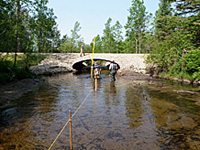
at a highway-stream crossing. A new
bottomless culvert structure was installed
that allows fish and other aquatic animals
to pass.
Stream crossings under public roads are an important link in the stream habitats that weave under the roads throughout Wisconsin. If the structure at the road-stream crossing is not sized properly or placed at the appropriate elevation, it can be detrimental to the stream system and more prone to flood damage during storm events. Use Field Indicators of Flood Prone Road Stream Crossings to determine if a local public road structure may be at risk.
To assess a stream crossing under a public road, please use the Municipal Supplemental Worksheet.
DNR staff may also be available to teach data collection methods. For assistance training volunteers, contact:
- Southern Wisconsin: Bobbi Jo Fischer
- Northern Wisconsin: Jon Simonsen
Culvert inventories
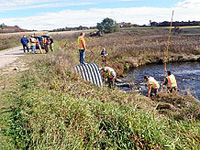
County trout stream is analyzed by
DNR EAS staff.
Using LiDAR data for screening structures
LiDAR data can be used as an excellent screening method for identifying fish passage barriers at road crossings. Check out the LiDAR RSX Report to access information about using LiDAR-Derived elevation data to determine if the road structures in your area may be barriers to fish and to find sites that are more likely to have flooding and maintenance problems.
Funding for projects to improve stream connectivity
There are many opportunities to secure additional funding for projects that strive to improve flood resiliency and stream connectivity. Opportunities include:
- inventories of streams within a watershed,
- replacing barriers on trout streams,
- replacing barriers near lakes,
- projects in flood-damaged areas,
- projects in the Great Lakes watershed, and
- replacement of high-priority barriers to stream connectivity.
For more information: