Assessments & Reporting
Submit Data
Submit Data for 2014 Assessments
Submit your data here for the 2014 waterbody assessments, from January 2 to March 3, 2013.
Do you have data on Wisconsin’s lakes, streams, or rivers?
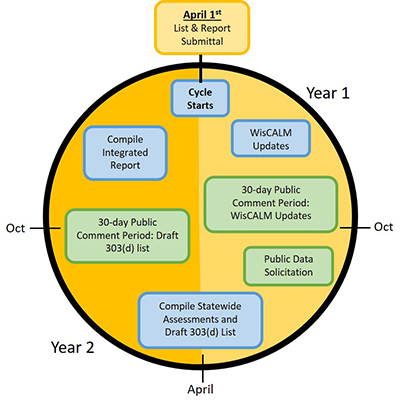
Every two years, the WDNR requests that citizens and interested groups submit their surface water data (biological, chemical, and physical). Data meeting specified requirements will be evaluated, along with Department data, to assess the quality of the state’s water resources and to pinpoint problem areas. In accordance with the Clean Water Act, the WDNR uses these assessments to prepare a statewide Integrated Water Quality Report (“Integrated Report”), which includes an updated list of Impaired Waters.
For the upcoming 2014 Integrated Report, data will be accepted from the public for a two-month period from January 2 through March 1, 2013.
Types of data to submit
You may submit any type of data, but a synopsis of data of particular interest to WDNR is shown in the following table, including a summary of minimum data requirements found in WisCALM 2014 (Data Solicitation Min Data Requirements Table ).
Specific data requirements must be met for WDNR to assess your data. More detailed guidance on minimum data requirements and how WDNR evaluates the data is available in the Wisconsin Consolidated Assessment and Listing Methodology (WisCALM). This guidance is currently undergoing revisions for the 2014 reporting cycle, but the 2012 version may be accessed under the tab "WisCALM" on this page.
Preparing your data
To enable the WDNR to efficiently process public data, data must be prepared and submitted to WDNR electronically in specific Excel spreadsheet formats, along with quality assurance documentation. Data received as .PDF files or in other hard copy formats will not be entered into the Excel spreadsheets by WDNR staff and may not be assessed.
The following four required elements must be emailed or mailed on CD to WDNR:
- A quality assurance plan describing protocols followed
- Data in the following specified Excel spreadsheet format: [Data Upload Template ]
- For any stations that do not have a DNR SWIMS Station ID number, you must provide locational information in the following specified Excel spreadsheet format: [Locational Template]
- Complete contact information for the submitter, including: Full name, mailing address, affiliation, phone number(s), email address(es).
Submitting your data
- Email your data and all required elements in the formats specified above to: dnrimpairedwaters@wisconsin.gov
- Or, submit a CD with the data and all required elements in the formats specified above via mail to:
Aaron Larson, WDNR
Bureau of Water Quality
101 S. Webster St. WQ/3
Madison, WI 53707
Questions?
Feel free to contact WDNR staff with any questions at dnrimpairedwaters@wisconsin.gov.
WisCALM
Assessments
Wisconsin has developed an assessment and listing methodology (WisCALM) for Clean Water Act reporting, the results of which are available in the 2012 Water Quality Report to Congress [1.28MB PDF]. WisCALM describes assessment protocols for waters to determine condition and to plan management options. Read WisCALM 2012 [1.28MB PDF]
Waters within targeted watersheds, or specific streams, rivers or lakes, were assessed by analyzing monitoring data or by reviewing historical and more recent information against assessment parameters or condition evaluation metrics. This work resulted in placement of the water along a condition gradient of "excellent" to "poor". Waters in "poor" condition were be further analyzed using specific evaluation techniques requiring minimum datasets and quality assurance to determine impairment.
WisCALM AssessmentThe choice of indicators for assessing water condition is based on recommendations from a cross-divisional team of researchers and practioners in fisheries, watershed, and water biology, pathology, ecology and chemistry. Wisconsin has incorporated the systematic use of these new metrics into its general (305(b)) assessment process, as well as its identification of impaired waters for Recreational Use, Fish Consumption, Fish and Aquatic Life, and Public Health and Welfare. Results from the 2010 assessment period were used to further advance the use of integrated ecological, biological and chemical assessment procedures.
Year 2012 WisCALM updates include:
- New phosphorus assessment methodology for lakes, rivers and streams.
- An improved method for evaluating Wisconsin’s Great Lakes and inland Beaches.
- A new reporting category for waters when impairments are suspected to be caused by natural or uncontrollable sources.
Reporting
2012 Integrated Report
Every two years Wisconsin prepares a Water Quality Report to Congress [1.28MB PDF], known as the Integrated Report (IR). The IR combines reporting requirements from Clean Water Act sections 305(b) and 303(d). Section 305(b) requires states to provide a summary of the overall health of waters and section 303(d) requires states to develop a list of waters that are not meeting water quality standards. This list is often referred to as the Impaired Waters List or 303(d) List. To make decisions on the condition of Wisconsin waters, Department staff use Wisconsin’s Consolidated Assessment and Listing Methodology (WisCALM) to determine if waters are meeting designated uses.
The 2012 Impaired Waters List
The 2012 Draft Impaired Waters List is now available for public review through February 20, 2012. Responses to comments will be available when the final state approved list is submitted to USEPA this spring. View the proposed Year 2012 changes to the Impaired Waters List.
The 2012 Water Quality Report
The 2012 report describes progress made on meeting designated uses. The result is a snapshot of water condition measured against expectations derived for each use designation. The 2012 report reflects a more detailed analysis of 23 of the state's 330 watersheds, as well as specific monitoring of targeted waters throughout the state. This report highlights the state's most degraded waters as they constitute the state's impaired waters as described in the Clean Water Act, Section 303(d).
Contact Information
For questions and comments about the Water Quality Report to Congress:
Aaron Larson, 608-264-6129
Condition
General Condition 
Data collected under WDNR’s tiered monitoring system are used to identify where a specific river or stream falls on a continuum of water condition, which is the core assessment to determine if a waterbody is attaining its applicable designated uses. WDNR uses four levels of condition to represent waters’ placement in the overall water quality continuum.
Waters described as excellent and good clearly attain each assessed designated use; waters described as fair are also meeting their designated uses, but may be in a state that warrants additional monitoring in the future to assure water conditions are not declining. Waters that are described as poor may be considered “impaired” and added to the Impaired Waters List in accordance with Section 303(d) of the federal Clean Water Act.
Impaired Waters
The assessment of whether a waterbody is meeting a specific designated use inherently requires comparison to applicable water quality criteria, or, when numeric criteria do not exist, a well-defined reference condition or attainable use as a benchmark for comparison to narrative standards. This section briefly outlines the concepts of indicators and associated thresholds to measure attainment status of Wisconsin lakes, rivers, and streams. For purposes of this guidance, the term “indicator” is used to describe the various measures of water quality, including those that represent physical, chemical, biological, habitat, toxicity, and body tissue data. The term “threshold” is used to when referring to the numeric value or narrative description that distinguishes attainment of the water quality standards versus values that indicate impairment. In the simplest sense, a waterbody is defined as “impaired” when it is not achieving any one of its designated uses – generally as a result of some human-induced activity that prevents the use from being fully attained.
Key Indicators for Assessments
Detailed assessments are tailored to the specific concerns for a waterbody. The assessment can include any of the parameters. Indicators are sub-divided into the following categories:
- Conventional physical-chemical indicators
- Toxicity-based indicators
- Biological indicators
- Lake eutrophication indicators
Exceedance Frequency
In the context of numeric water quality criteria, exceedance frequency refers to the number of times a criterion may be exceeded over a period of time before the water is considered impaired. If Wis. Adm. Code does not specify what constitutes an exceedance of the water quality criteria for specific parameters, exceedance criteria for those parameters are outlined in this WisCALM document in the Lakes and Rivers/Streams chapters. Exceedance criteria that are outlined in guidance must be in line with the intent of the criteria in code. In some cases, WisCALM lists impairment thresholds for parameters that do not have codified water quality criteria (for instance, chlorophyll a). For parameters that do not have codified criteria, their impairment thresholds may be used as guidance for listing, but a waterbody does not have to be listed based on that parameter alone. In addition, a waterbody will be placed on the Impaired Waters List if it is not meeting any one of its designated uses, independent of whether or not the water is meeting water quality criteria.
Impairment Thresholds
Impairment thresholds are applied to determine whether waterbodies should be placed on the Impaired Waters List. These thresholds are usually expressed as ambient water concentrations of various substances based on numeric water quality criteria included in chs. NR 102-105, Wis. Adm. Code, WDNR technical documents, and federal guidance. In some cases, qualitative thresholds based upon narrative standards may be used to make impairment decisions. In those cases, a thoroughly documented analysis of the contextual information should be used in conjunction with professional judgment to collectively support a decision.
For some assessments methods, a single criterion or threshold may not be applicable across all the different waterbody types. For example, large shallow lakes in the southern portion of the state have naturally higher nutrient concentrations than the small shallow lakes in the northern part of the state. An initial waterbody classification analysis is required to ensure the assessment process applies the correct impairment threshold. For other assessment methods, the WDNR applies the same water quality criterion or threshold across all resource types. An example is the use of the same fish tissue mercury concentration for all our lakes and rivers in the assessment of Fish Consumption Advisories as part of the Public Health and Welfare Use (chapter 6.1).
Data Quality
Information used for assessments must be consistent with the WDNR Quality Management Plan or have been obtained using comparable quality assurance procedures. In general, monitored information contained in WDNR databases will be used, unless more recent information is available. These data will be used unless experts determine that the data are no longer representative of current conditions. Department staff will determine if changes in the watershed have occurred, such as significant changes in land use, decreases of nonpoint source controls, or increases in the amount of pollutants discharged from point sources. Proposed changes to the Impaired Waters List must be based on assessment methods identified in WisCALM or equivalent, documented methods.
Listing Waters
List or Delist Waters
Once data have been assessed to determine whether any parameters indicate impairment of a waterbody, a decision to list a waterbody as impaired or to delist a waterbody should be made. There are several nuances to this decision that are discussed in this chapter. These include resolution of conflicting results from different parameters on a waterbody, identification of which Use Designations are impaired, determination of the appropriate EPA category, and identification of “Causes” and “Sources” of impairment.
When minimum data requirements are met, an attainment decision should be made and documented unless there are circumstances that warrant a non-decision. When a decision is made to not list a waterbody due to few or insufficient data, that water should be included on a list of Watch Waters to be monitored as resources allow in order to allow sufficient data to be available for upcoming Impaired Waters Listing cycles.
Independent Applicability & Tools to Resolve Data Conflicts
Under Federal guidance, a water shall be listed on the Impaired Waters List if data is reflective of current conditions, data has met minimum data requirements, and the water does not meet water quality standards, including water quality criteria, designated uses, and/or antidegradation. This decision philosophy is referred to as independent applicability, consistent with the Clean Water Act that protects biological, chemical, and physical integrity of surface waters. However, EPA recognizes that there are certain situations in which factors beyond a strict interpretation of Independent Applicability should be considered to make the most appropriate listing decision. Accordingly, EPA allows states to formulate specific decision rules pertaining to circumstances under which one type of parameter should be given a greater ‘weight’ than others. Wisconsin has developed decision rules that use a hierarchy of indicators for certain parameters, which are described within the Lakes and Rivers & Streams chapters of this guidance document.
If one of the water quality standards are not met, but multiple data sets produce conflicting results (some indicating impairment and some not), WDNR staff should review all available data to assist in making an attainment decision. There are several factors biologists may use to resolve these differences to arrive at a listing decision. A decision matrix is described in Figure 14 to describe the process for not making attainment decisions using independent application. Cases where this process is used will be rare and should be well documented for that water in the WATERS database.
Data quality differences
If one parameter indicates impairment but another does not, differences between the two data sets in data quality, data quantity, analytical methods, sampling technique or statistical confidence may provide reason to weight one set of data more heavily than another.
Site-specific factors
Natural background levels of a pollutant may be higher than impairment thresholds or uncontrollable factors may cause an exceedance of water quality standards. In these circumstances, WDNR will determine whether criteria exceedance are reasonably expected to be due to natural or uncontrollable causes, as defined in the “Six Factors” of Use Attainability Analysis (40 CFR 131.10(g)). If assessment documentation supports that impairment is due to natural or uncontrollable factors, a Use Attainability Analysis (UAA) should be pursued to modify the Designated Use and/or associated criteria. However, a water with suspected naturally occurring pollutant levels that exceed applicable water quality criteria should be placed on the Impaired Waters List under Category 5C, until the appropriate designated use and/or site-specific water quality criteria have been approved by WDNR and EPA. Category 5C waters are those that are identified as impaired, but the cause of the impairment may be attributed to natural or uncontrollable source(s).
Weight of Evidence
In certain cases where two data sets conflict with one another, states may apply a “weight of evidence” approach. This approach helps define the extent of the problem based on how it impacts the Designated Use, and allows biologists to consider aspects of the data that might indicate whether one data set should be weighted more greatly than another. In all cases, Department staff will look for corroborating information, such as the various habitat and biological indices and water chemistry data. If the suite of available data does not suggest an evidentimpairment, then the water will not be listed, but will be recommended for additional monitoring as resources allow. WDNR will provide a rationale for those cases where data are available that show that a water quality criterion has been exceeded, but the water has not been recommended for the impaired waters list. In most cases, the indicator has not reached the magnitude, duration or frequency to warrant placing a waterbody on the list.
Hierarchy of Indicators
In some situations, a hierarchy of the indicators may be appropriate. For example, biological indicators (e.g., fish or macroinvertebrate IBI) for assessment of the fish & aquatic life use may have precedence over chemical indicators in the impairment decision process, because they are direct measures of health of aquatic life. However, this hierarchical approach should be used with caution, knowing that exceedance of chemical indicators may correspond to a more recent event that was not reflected in the biological community data due to differences in collection periods or delays in community response. In such a case, a decision to rely on a hierarchical approach would be inappropriate.
More business resources