
Common buckthorn
(Rhamnus cathartica)
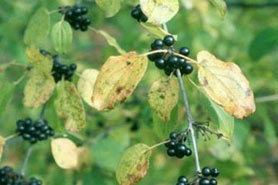
Tall understory shrub or small tree up to 20-25’ tall, often with several stems arising from the base and spreading crown. Gray to brown bark with prominent light-colored lenticels. (Caution: native plums and cherries have a similar bark). Plants are either male or female. Cut bark exposes yellow sapwood and orange heartwood. Twigs often end in stout thorns.
Other names for this plant include:
- Common names: Carolina buckthorn, European buckthorn
Classification in Wisconsin: Restricted
- Ecological Threat
-
- Invades oak forests, riparian woods, savannas, prairies, old fields, and roadsides. It thrives particularly on well-drained soils.
- Common buckthorn has a broad environmental tolerance. It leafs out very early and retains its leaves late into the growing season, giving them a longer growing season than native plants.
- Creates dense shade, eliminating the regeneration of tree seedlings and understory species.
- Allelopathic; produces chemical compounds that inhibit the growth of other vegetation.
- Identification
-
Leaves & stems: Ovate or elliptic, with prominent veins curving toward the tip. Mostly opposite leaves, 1-2.5” long, with tiny teeth. Leaves remain on plants and stay green into fall. The bark is gray to brown with prominent light-colored lenticels. Cut bark exposes an orange inner cambium layer.
Flowers: Inconspicuous, small and clustered in leaf axils. Fragrant, greenish-yellow, 4-petaled flowers that bloom in spring.
Fruits & seeds: Abundant clusters of round, black, pea-sized fruit. Ripen on female plants in late summer. Birds and mammals disperse them. Fruits remain on plants into winter after all the leaves have fallen.
Roots: Extensive, black fibrous root system.
Similar species: Glossy buckthorn (Rhamnus frangula; invasive) is identical to common buckthorn. Leaves are mostly opposite, with a more significant number of veins. The upper surfaces of leaves are shiny with the undersides dull.
Alder buckthorn (Rhamnus alnifolia; native) is under 3’ tall with thornless twigs. Lance-leafed buckthorn (R. lanceolata; native) is less than 6’ tall, found in wet areas and on dry limestone slopes, and has alternate leaves, 2-6” long, gradually tapering to a point at the tip. Carolina buckthorn (R. caroliniana; native), found in the southern Midwest, is 10-30’ tall with toothed, mostly alternate leaves, 2-3” long.
- Control
- Mechanical:
- Small plants may be hand-pulled and prescribed fire for seedlings. Larger plants can be dug or pulled using a leverage tool such as a weed wrench.
- Girdling trees require stripping the bark to expose the inner hardwood at a minimum of six inches. Adequate any time of year.
- Cut-stump treatment with glyphosate in late fall
- Cut-stump or basal bark spray treatment around the stem with triclopyr ester in late fall through the winter.
For more information on control techniques, visit the Common buckthorn factsheet [exit DNR] by the University of Wisconsin-Extension.
- Resources
- Sources for content:
- Czarapata, Elizabeth; Invasive Plants of the Upper Midwest: an illustrated guide to their identification and control. The University of Wisconsin Press. 2005. Pg. 35-41
- University of Wisconsin-Extension. Common buckthorn factsheet [exit DNR].