LOWER GREEN BAY AND FOX RIVER AREA OF CONCERN
About
About The Lower Green Bay And Fox River AOC
In 1987, Lower Green Bay and the Fox River below the De Pere Dam was listed as one of 43 Great Lakes Areas of Concern (AOCs) under the Great Lakes Water Quality Agreement between Canada and the United States. The goal of the AOC program is to prioritize remediation and restoration efforts in the most degraded areas of the Great Lakes.
Shortly after the AOC designation, the DNR worked with community stakeholders to develop a Remedial Action Plan in 1988. This plan described the key issues leading to the AOC designation, which include contaminated sediment, poor water quality, and lost or altered fish and wildlife habitat. Furthermore, the plan contained a vision for the future and outlined the key actions and recommendations necessary to address these key issues.
In 1993, the DNR worked with community stakeholders to develop a Remedial Action Plan Update, which incorporated research leading to the development of a list of 11 confirmed and two suspected Beneficial Use Impairments (BUI) intended to describe the environmental problems that needed to be addressed to achieve the desired vision. For more information on BUIs and their status, visit the “Impairments” tab.
In 2009, the DNR worked with technical experts and community stakeholders to develop BUI Removal Targets to measure when enough action has occurred to remove those impairments from the list of environmental problems in the AOC. Once all BUIs have been removed, the AOC can be considered for delisting, which removes the AOC designation and reflects that the area is on par with other less degraded areas of the Great Lakes.
AOC Boundaries
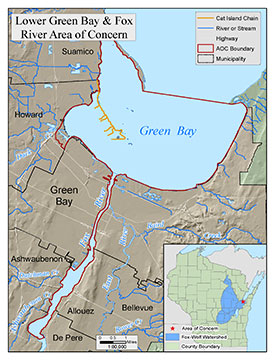
Map showing Lower Green Bay and Fox River AOC boundary and the Fox-Wolf Watershed.
The Lower Green Bay and Fox River AOC includes the last seven miles of the Fox River from the De Pere Dam to the mouth of the river and extends into a 21-square mile area of Lower Green Bay below Longtail Point on the west shore and Point au Sable on the east shore.
AOC Goals And Actions
The DNR continues to work with community stakeholders and partners in updating Remedial Action Plans using an iterative and continuous improvement approach, though the following overarching goals and actions identified in the plans include:
- Remediate polychlorinated biphenyl (PCB) and polyaromatic hydrocarbon (PAH) contaminated sediment in the Fox River and nearshore waters of Green Bay.
- Reduce non-point source pollution.
- Enhance fish and wildlife habitat and increase their populations.
Many substantial environmental improvements in the AOC have been made to date through partnerships with community stakeholders, technical experts, and various local, state and federal agencies and organizations. For more information on community engagement and partnerships to advance progress in the AOC, visit the "Community Engagement" tab.
Community Engagement
The DNR collaborates with many local, state and federal agencies, community groups, technical experts and other stakeholders to advance AOC restoration and remediation efforts, while placing an emphasis on community engagement. Some key groups that work with DNR to achieve these goals are described below.
COMMUNITY ADVISORY COMMITTEE
Community Advisory Committees (CACs) typically provide “communication in” on community interests to agencies coordinating the AOC program as community representatives and liaisons, as well as “communication out” by engaging and leveraging their respective networks within the community about AOC program and agency priorities.
In the Lower Green Bay and Fox River AOC, a CAC, known as the Clean Bay Backers, was established early in the development of the first AOC Remedial Action Plan. More recently, the group has led “Bringing Back the Bay” tours targeted toward community leaders and elected officials. The representation, role and focus of the Clean Bay Backers has changed over the past 35 years, partly owing to a lack of consistent local, state and federal resources to maintain momentum and compensate individuals coordinating CACs.
Recently, the DNR partnered with New North, Inc. to recruit a re-established CAC that will be compensated for their time and lived experience as community members in northeast Wisconsin. This effort is made possible by support from the Fund for Lake Michigan. The CAC began in October 2024.
LOCAL LEADERSHIP COUNCIL
The Local Leadership Council is made up of municipal and community leaders that come together to work through opportunities and challenges that cut across multiple projects, such as providing feedback on how AOC projects integrate with urban development projects, long-term maintenance of habitat restoration sites, methods of engaging the public in decision-making and providing outreach to the community on AOC progress.
Representatives from Brown County, Outagamie County, City of Green Bay, City of De Pere, Village of Allouez, Village of Ashwaubenon, Village of Howard, Village of Suamico and NEW Water participate in the group and generally meet on a bi-monthly basis.
TECHNICAL ADVISORY COMMITTEES
Several technical advisory committees (TACs) provide specific expertise and recommendations to DNR on various AOC projects and initiatives. Members include resource experts that work at the local, state and federal level. Current TACs involved in consensus-based decision making to provide recommendations to DNR include:
- Fish and Wildlife TAC
- Fisheries Subcommittee
- Native Mussels Subcommittee
- Toxic Substances TAC
- Benthos and Phytoplankton TAC
- Keepers of the Fox Implementation Work Group
Stay Informed And Get Involved
To learn more about AOC news, community events, volunteer opportunities and more, check out these resources
- Reach out to Brie Kupsky, Green Bay Program Coordinator
- Subscribe to the Green Bay Conservation Partners listserv [exit DNR]
- Clean Bay Backer Brochure [PDF]
Maps
Maps
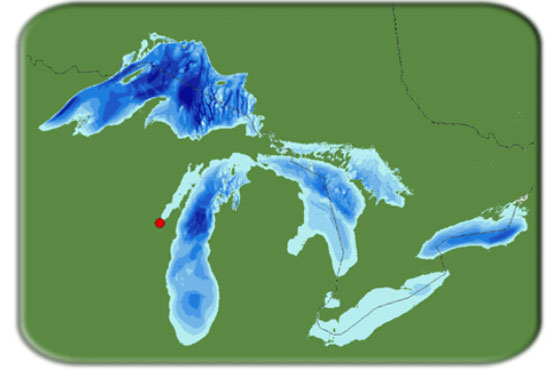
Location of the Lower Green Bay & Fox River Area of Concern in relation to all Great Lakes.
Sediment Remediation
The Lower Fox River PCB Cleanup effort began in 2004 with active cleanup operations completed in 2020 and is one of the largest cleanup efforts of its kind worldwide. For the cleanup operation, the Lower Fox River was divided into five Operable Units (or OUs) based on physical and geographical characteristics of the Lower Fox River. For more information, visit the Lower Fox River PCB Cleanup Project webpage.
Non-Point Source Pollution Reduction In The Fox-Wolf Basin
While the AOC is where some of the most severe water quality issues proliferate, land use in the 6,429 square mile Fox-Wolf watershed basin contributes significantly to water quality issues downstream in the AOC. A watershed basin includes all the land and water areas that drain toward a particular lake or river outlet, and what is done on the land is reflected in its receiving waters. All streams in the Upper Fox and Wolf River basins eventually drain to the Lake Winnebago Pool Lakes and Lake Winnebago, which then drains to the Lower Fox River and eventually empties into the Bay of Green Bay.
To fully restore the AOC, restoration actions in the Fox-Wolf watershed will be needed to improve water quality and will continue for many years after AOC delisting. A Total Maximum Daily Load (TMDL) or “phosphorus and sediment diet” has been developed for both the Upper Fox and Wolf Rivers and Lower Fox River basins, which supports the continued development and implementation of several Nine Key Element Plans to reduce nutrient and sediment loading to the AOC.
The Lower Green Bay and Fox River Area of Concern includes the last seven miles of the Fox River from the De Pere Dam to the mouth and extends into lower Green Bay up to an imaginary line crossing the bay from Long Tail Point to Point au Sable.
Although this part of the River and Bay is where water quality is most severely impacted, land and water uses upstream in the Fox–Wolf basin also have a great impact on the Area of Concern. To fully restore the Area of Concern a "watershed approach" will be needed to address upstream water quality.
![Lower Green Bay and Fox River AOC map with satellite imagery [PNG]](https://dnr.wisconsin.gov/sites/default/files/topic/GreatLakes/images/Updated_LGBFR-AOC_MapWithSatelliteImagery.png)
Impairments
Impairments
A “beneficial use” is any way that a water body can improve the quality of life for humans (such as providing fish that are safe to eat) or for fish and wildlife (such as providing adequate habitat). If the beneficial use is unavailable or reduced due to environmental problems, that use can be considered impaired. A description of each impairment can be found on the U.S. EPA Great Lakes AOCs website [exit DNR].
Of the 14 possible Beneficial Use Impairments (or BUIs), 11 were listed as confirmed and two were listed as suspected in the Lower Green Bay and Fox River AOC in the late 1980s and are listed in the table below.
| Beneficial Use Impairement | Listing Status | Source of Impairment | Current Status |
|---|---|---|---|
| Restrictions on Dredging Activities | Confirmed | Contaminated Sediment | BUI removed Sept. 2021 |
| Fish Tumors or Other Deformities | Suspected | Contaminated Sediment | Suspected |
| Bird or Animal Deformities or Reproduction Problems | Confirmed | Contaminated Sediment | Confirmed |
| Restriction on Fish and Wildlife Consumption | Confirmed | Contaminated Sediment | Confirmed |
| Degradation of Benthos | Confirmed | Contaminated Sediment, Water Quality Degradation, Loss of Fish and Wildlife Habitat | Confirmed |
| Degradation of Phytoplankton and Zooplankton Populations | Confirmed | Contaminated Sediment, Water Quality Degradation | Confirmed |
| Loss of Fish and Wildlife Habitat | Confirmed | Loss of Fish and Wildlife Habitat | Confirmed |
| Degradation of Fish and Wildlife Populations | Confirmed | Contaminated Sediment, Water Quality Degradation, Loss of Fish and Wildlife Habitat | Confirmed |
| Restrictions on Drinking Water Consumption, or Taste and Odor Problems | Confirmed | Contaminated Sediment, Water Quality Degradation | BUI removed Jan. 2025 |
| Beach Closings | Confirmed | Water Quality Degradation | Confirmed |
| Eutrophication or Undesirable Algae | Confirmed | Water Quality Degradation | Confirmed |
| Degradation of Aesthetics | Confirmed | Contaminated Sediment, Water Quality Degradation, Loss of Fish and Wildlife Habitat | BUI removed April 2022 |
| Tainting of Fish and Wildlife Flavor | Suspected | Contaminated Sediment, Water Quality Degradation | BUI removed April 2020 |
BUI Removal Process
After actions are completed to address BUIs, verification monitoring is usually conducted to determine if the actions have achieved the desired AOC outcomes. If monitoring data shows that BUI removal criteria were met, then DNR initiates the BUI removal process. DNR prepares a report summarizing the source of the impairment, removal objectives, actions taken to address the impairment, and information showing achievement of removal objectives and justification for the removal.
The process also includes consultation with stakeholders, a technical review by designated federal agency experts, and a public comment opportunity to review the document and respond to the recommendation to remove the BUI. A BUI is formally removed when stakeholders and U.S. EPA’s Great Lakes National Program Office concurs with the removal recommendation and a responsiveness summary is typically included detailing the feedback and responses received during the public comment review period.
Final BUI removal packages with cover letters
To date, the following BUIs have completed the formal removal recommendation process:
- Restrictions on Drinking Water Consumption or Taste and Odor Problems BUI removal package [PDF] - Removed Jan. 2025
- Degradation of Aesthetics BUI removal package [PDF] - Removed April 2022
- Restrictions on Dredging Activities BUI removal package [PDF] - Removed Sept. 2021
- Final Tainting of Fish and Wildlife Flavor BUI removal package [PDF] - Removed April 2020
AOC plans
Remedial Action Plans
Following publication of the first Remedial Action Plan (RAP) in 1988, the DNR and stakeholders developed approaches to address 11 confirmed and two suspected beneficial use impairments. Monitoring was often a first step to understand conditions and inform the selection of actions. Some actions or projects selected to address specific impairments are documented in management action lists. They describe the needed work and explain how the projects will help remove the impairments. The DNR develops management action lists in consultation and partnership with AOC stakeholders and submits them to EPA for concurrence.
DNR updates the RAP periodically to share progress on management actions, provide a summary on monitoring results and describe next steps for addressing beneficial use impairments. Each RAP Update undergoes a public comment opportunity for stakeholders to review the document and respond to the updates and path forward for addressing beneficial use impairments. To stay informed about public input opportunities for upcoming RAP Updates, sign up to receive GovDelivery notifications:
Below are links to the RAP Updates and a description of key information included in each.
| Remedial Action Plan | Key Information |
|---|---|
| 2020-2021 Remedial Action Plan Update [PDF] |
|
| 2019 Remedial Action Plan Update [PDF] |
|
| 2018 Remedial Action Plan Update [PDF] |
|
| 2017 Remedial Action Plan Update [PDF] |
|
| 2016 Remedial Action Plan Update [PDF] |
|
| 2015 Remedial Action Plan Update [PDF] |
|
| 2014 Remedial Action Plan Update [PDF] |
|
| 2013 Remedial Action Plan Update [PDF] | Updates on projects and priorities, including:
|
| 2012 Remedial Action Plan Update [PDF] | Updates on projects and priorities, including:
|
| 2011 Stage 2 Remedial Action Plan Update [PDF] | Updated summary of beneficial impairment status and initial list of specific actions that will be important for reaching the removal targets to achieve AOC delisting. |
| 2009 Area of Concern Beneficial Use Impairment Delisting Targets [PDF] | Initial beneficial use impairment targets developed to describe when each impairment should be considered sufficiently addressed to achieve AOC delisting. |
| 1993 Area of Concern Remedial Action Plan Update [PDF] | Specific environmental problems described in the initial RAP are formally categorized and listed as 11 confirmed and two suspected Beneficial Use Impairments with updated recommendations on how to address them to achieve AOC delisting. |
| 1988 Area of Concern Remedial Action Plan [PDF] | Initial background and history of specific environmental problems in the Lower Green Bay and Fox River AOC and the Lower Fox River Watershed and recommendations on how to address them to achieve a desired future state. |
Projects
Establishing Projects
To date, several projects are in various stages of planning, design, construction, and maintenance that are designed to address the 11 confirmed and two suspected beneficial use impairments (BUIs) identified for the Lower Green Bay and Fox River AOC. The DNR works with many partners and community members to identify and implement pollution cleanup and restoration projects based on several factors, including:
- Ability of the projects to help remove the impairments.
- Benefits that the projects provide to the community and environment.
- Long-term use and maintenance of the project sites.
- Feasibility of conducting the necessary work.
MANAGEMENT ACTIONS
Projects in the Lower Green Bay and Fox River AOC are categorized by the environmental issues they are intended to address, including those that can remediate contaminated sediment, improve degraded water quality and restore lost fish and wildlife habitat.
CONTAMINATED SEDIMENT MANAGEMENT ACTIONS
The Lower Fox River PCB Cleanup is the primary project intended to address all BUIs present because of sediment contamination. Active cleanup operations began in 2009 and were completed in 2020, resulting in over 8,000,000 cubic yards of contaminated sediment remediated from the Lower Fox River. Long-term maintenance and monitoring will be ongoing until Remedial Action Objectives are met, in accordance with state and federal regulations and an agency-approved Long Term Monitoring Plan. For more information, visit the Lower Fox River PCB Cleanup Project webpage.
DEGRADED WATER QUALITY MANAGEMENT ACTIONS
The DNR has worked with stakeholders for several years to refine the targets that will define success for the AOC program but are not duplicative of other program goals or regulatory compliance functions. The Total Maximum Daily Load (TMDL) Program has defined the amount of total phosphorus and sediment the Lower Fox River can receive and still meet water quality standards, and through that program stakeholders are working to implement watershed restoration plans in the Lower Fox River Basin and Upper Fox and Wolf River Basin. The DNR Office of Great Waters continues to work with these stakeholders to identify a specific contribution for the AOC Program in implementing watershed restoration projects in the Lower Fox River Basin.
- Lower Fox River TMDL Report [PDF]
- Upper Fox and Wolf River TMDL Report [PDF]
- Lower Fox River Watershed Recovery Plan Executive Summary [PDF]
Lost Fish and Wildlife Habitat Management Actions
A list of 12 habitat restoration project locations, concepts and overarching goals was developed from 2018 – 2020 through a consensus-based process with the AOC Fish and Wildlife Technical Advisory Committee and built on several years of effort to better understand the condition of fish and wildlife habitat and populations in the AOC. This process informed the development of a management action plan that was shared with and reviewed by several community partners from 2020 – 2023. The Lower Green Bay and Fox River AOC Fish and Wildlife Management Action Plan was approved by the EPA Great Lakes National Program Office on July 17, 2024. When completed, these projects are expected to improve the condition of 18 priority native habitat communities and 22 priority native fish and wildlife population groups.
- Habitat Restoration Plan and Path Toward Delisting [PDF]
- Fish and Wildlife Habitat Assessment and Wildlife Habitat and Water Quality Opportunities [PDF]
- Evaluating Progress Toward Removing Fish and Wildlife Habitat and Populations Beneficial Use Impairments [PDF]
- Lower Green Bay and Fox River AOC Fish and Wildlife Management Action Plan [PDF]
IMPLEMENTING PROJECTS
Many partners are working together to complete these projects, including local, state and federal agencies, community groups and other stakeholders. Major funding for projects in the Lower Green Bay and Fox River AOC is from the Great Lakes Restoration Initiative administered by U.S. EPA and Fox River Natural Resource Damage Assessment administered by the Fox River Trustee Council [exit DNR].
Resources
Links Relating to the Lower Green Bay and the Lower Fox River
- Lower Green Bay and Fox River Accomplishments Fact Sheet [PDF]
- Beneficial Use Impairment (BUI) Restoration Report - Fall 2022 [PDF]
- Green Bay Estuary Digital Archives Collection [exit DNR]
- Eating Your Catch - Fish Consumption Advice
Videos
Cat Island - Rebirth of an Environment
Plovers are back in Green Bay!