
Mile-a-minute vine
(Polygonum perfoliatum or Persicaria perfoliata)
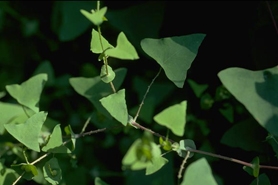
A rapid growing herbaceous annual vine that can grow to be 20’ tall with support from nearby vegetation. It has delicate reddish stems that are covered with barbs.

Other names for this plant include:
- Common names: Asiatic tearthumb, devil's tail tearthumb
- Scientific names: Persicaria perfoliata; Ampelygonum perfoliatum
Classification in Wisconsin: Prohibited
- Ecological Threat
-
- Prefers moist areas and invades woodland edges, wetlands and stream banks where the buoyant seeds can disperse easily.
- Smothers native plants by growing up to 6” in one day.
- Identification
-
Leaves: An equilateral triangle, with three sides that are all the same length. They are simple, alternate and light green. It has barbs on the underside and there are circular, cup-shaped leaves at intervals on the stem.
Flowers: Appear in saucer-shaped leaves, are white, inconspicuous and closed.
Fruits & seeds: Segmented pea-sized berries are metallic blue with each segment containing one seed. Spread by water, birds, ants and other animals.
Roots: Fibrous.
Similar species: Native tearthumbs are distinguished easily from mile-a-minute vine’s fruit that look like berries and triangle-shaped leaves that are equal on all sides.
- Distribution
-
Currently, there have been no reports of mile-a-minute vine in Wisconsin. Have you seen it? Send us a report.
- Control
-
Mechanical: Pull populations and let dehydrate in the sun for several days. Repeated mowing or cutting will prevent flowering and seed production. WEAR THICK GLOVES!
Chemical: Glyphosate and clopyralid can be used for foliar sprays.
- Resources
- Sources for content:
- Czarapata, Elizabeth; Invasive Plants of the Upper Midwest: an illustrated guide to their identification and control. University of Wisconsin Press. 2005. Pg. 130